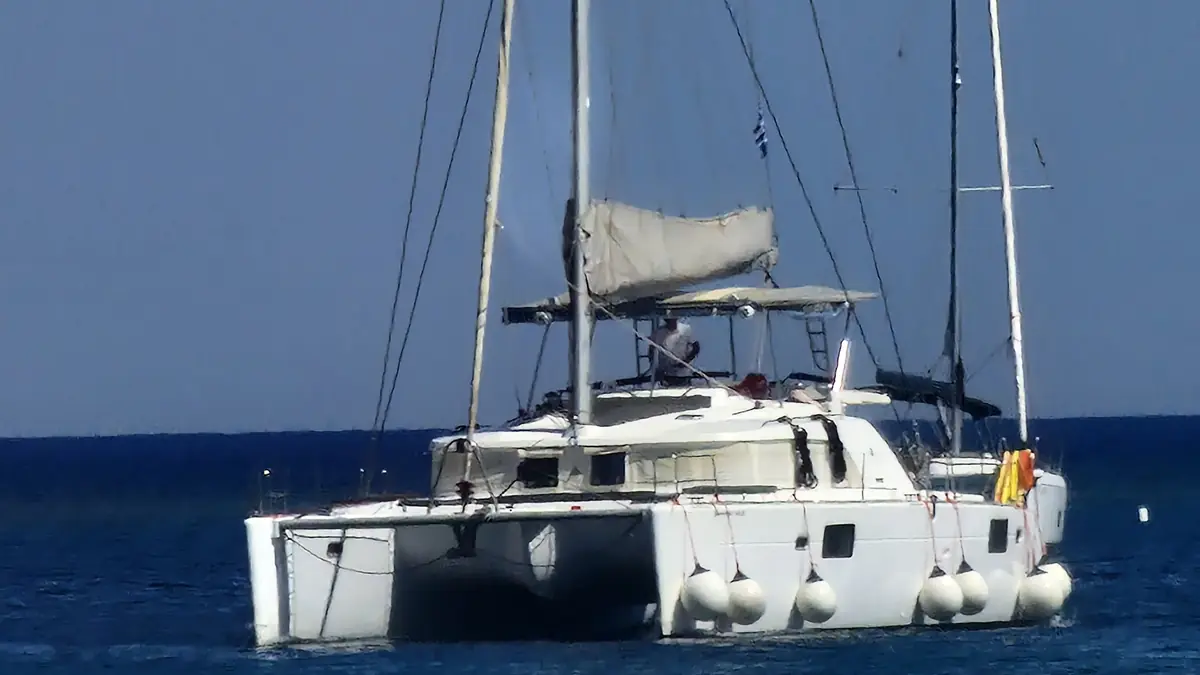
This is the question we get asked quietly at the marina more than any other — usually while the rest of the group is already photographing the boat. It deserves a straight answer rather than a brochure one, so here is what the water actually does, what the boat actually does, and what we've watched work across a few thousand guests.
The caldera is not the open sea
Look at Santorini on a map: the island curls around the water like a protective arm, with Thirasia closing most of the gap. That's because the "bay" you cruise is the drowned crater of the volcano — the cliffs you photograph are its walls, and they do to the ocean swell what a harbour wall does: break it. The 18-nautical-mile loop we sail — Red Beach, White Beach, Akrotiri and Mesa Pigadia, the lighthouse, the volcano and the caldera panorama below Fira — stays inside or close to that shelter the whole day. There's no ferry-to-Crete stretch of exposed water anywhere in it.
Two hulls beat one stomach
The boat matters as much as the water. Our Lagoon 44 is a catamaran: two hulls, a wide stance, and none of the pendulum roll that makes monohull sailboats feel like a slow metronome. A catamaran doesn't lean when it sails — your wine glass stays where you put it, and the sensation underfoot is closer to a moving terrace than a rocking boat. It's the single biggest reason we can honestly tell nervous guests to relax: the physics is on your side before you've even swallowed a ginger sweet.
The honest part: the meltemi
We promised honesty, so: July and August afternoons bring the meltemi, the dry northern wind of the Aegean. Inside the caldera it mostly means chop — a fizzy, slappy surface rather than rolling swell — and the ride between two of the stops can get bouncy for fifteen or twenty minutes. Kids typically declare this the best part. If you're susceptible, it's the one window where you'll want to be sitting aft with your eyes on the cliffs. And when the wind is genuinely too much, nobody sails: the port authority closes the sea, and our weather policy gives you a full refund or a free rebooking. The days you could feel rough on are, by regulation, the days no boat leaves Vlychada.
What works (crew-observed, not pharmacy-sponsored)
- Tablets, one hour before. Any standard motion-sickness tablet. Taken at the marina after you feel it, they mostly treat regret.
- Sit aft, look far. The stern moves least and the horizon recalibrates your inner ear. The saloon with your eyes on a phone does the opposite.
- Eat normally, drink some water. An empty stomach is a worse sailor than a full one. Save the serious wine tasting for anchor stops — the water is flat there anyway.
- The wristbands. Some guests swear by acupressure bands. We stock no opinion, only the observation that believing in them appears to be the active ingredient — which still counts as working.
- Swim stops reset everything. Ten minutes in the water cures more queasiness than anything sold in a blister pack. Conveniently, the day is built around them.
Our actual record
Across a full season, the number of guests who are properly seasick on a caldera cruise fits on one hand — and nearly every case involved a heavy night in Fira beforehand, which we respectfully decline responsibility for. The crew keeps water, shade and a practised total lack of drama on standby. If you're the anxious one in your group: come. The caldera has converted worse sceptics than you.